Teaching

Teaching Philosophy


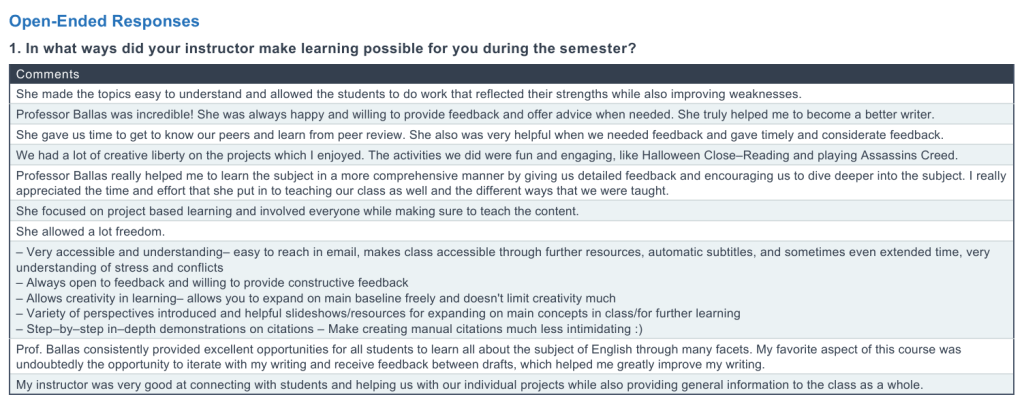
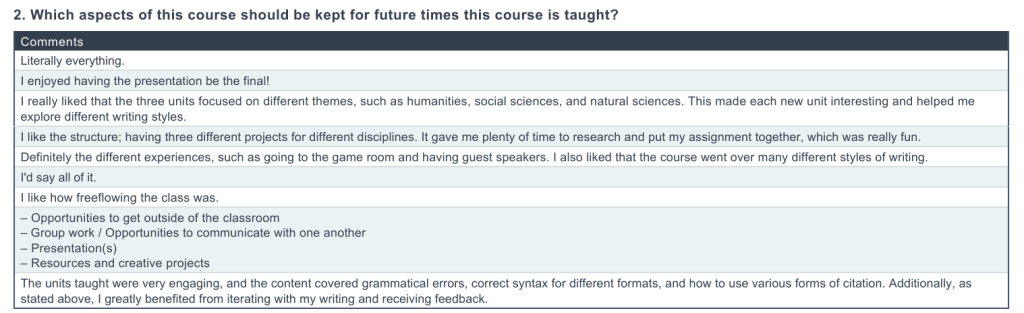
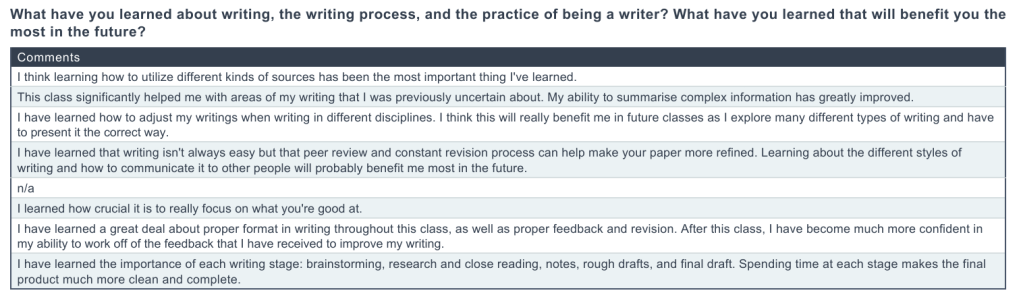
“I hope that I say something that unsettles you.” This was the opening statement of Dr. Cornel West’s lecture during his visit to my alma mater, Metropolitan State University of Denver in 2014. Although he was determined to unsettle those of us in his audience, he was exuding with love. I’ve developed my teaching philosophy around similar tensions because I believe they give rise to true knowledge.


My classroom practice begins with defamiliarization, a process that allows us to return to details and reintroduce ourselves to the world, systems, habits, and relationships to which we have grown overly accustomed. Defamiliarization encourages us to slow down and shed our assumptions. I begin each class with freewriting where we acknowledge those frustrating words stuck on the tips of our tongues, or see how far our minds can wander when meditating on single adjectives or a Hieronymus Bosch scene. In teaching rhetoric and composition, an emphasis is placed on building strong arguments and synthesizing information, which are positive skills, but they tend to overshadow the equally important, though difficult skill of asking questions. Naturally, defamiliarization sets us up to ask questions, even when orbiting the seemingly obvious, and even in a world overly saturated with data and search engines.

Defamiliarization may segue into growing pains. I view higher education as an emergent moment where we break through the chrysalis formed throughout primary and secondary education. Rather than hold each student to a single standard, my assessments are rooted in self reflections which measure their growth, their reception to feedback, their contributions, and their ability to identify their own strengths and weaknesses. Additionally, I learn a lot from the student’s reflections, prompting my own defamiliarization—their metacognition reveals thoughtful and creative insights about the learning process, and I’m given the opportunity to turn individual weaknesses into collective learning outcomes.

Trust and transparency are elements of my classroom practice that I continue to strive towards, both for students and for myself. Having always been a committed and curious student, thought not necessarily a perfect one, I draw on my own academic struggles to effectively reach students, regardless of their learning style or comprehension. This perspective allows me to meet students where they are and to normalize uncertainty as part of learning. All of this shapes my third tenet, recognition, by encouraging students to see themselves, while keeping their peers, their communities, their society, and the world in mind while pursuing their individual paths. Together, these principles frame learning as an ongoing process of reflection, ethical engagement, and mutual recognition rather than mastery alone.


English 105 Unit Projects


Reading for the Humanities

“The Medium is the Message”

Marshall McLuhan argues that the medium through which we communicate can be more meaningful than the content we aim to deliver. From podcasts, streaming services, video games, and print, each medium uniquely shapes how we consume and interact with the world. McLuhan claims that our experience with these mediums supersedes the content, which leaves me wondering how this reading would pair with Jane Gallop’s argument in “Close Encounters: The Ethics of Reading.” In it, she claims that close reading for minor details is more meaningful that the big picture and main ideas. It’s very interesting to see how new genres continue to change the age-old debate about form and content. Long live the humanities!

Rhetorical Theory & Practice

My first year teaching ENGL 105 was paired with a course called Rhetorical Theory and Practice with Dr. Daniel Anderson. In this course, we would convene to discuss areas of success and shortcomings in teaching 105. This class exposed me to different readings and assignments that broadened my approach to teaching. I’ve included some highlights below:


Podcasting

My first experience podcasting was with a group of my peers. We were asked to talk about Jane Gallop’s article, “Close Encounters: The Ethics of Reading,” which is a piece that changed the way I look at reading, writing, and teaching the language arts. Gallop’s article argues for close reading practices, to avoid drawing assumptions and projecting our own ideas onto the page, and that close reading makes us better listeners as well. This was one reason why Gallop’s article was a unique topic for our podcast discussion.

As an experience, podcasting comes with a level of unpredictability, which makes it both nerve-racking and liberating at once. It also felt like a communal process, with added layers of responsibility, compared to the valuable, though isolated process of writing. I appreciate the experience I had podcasting alongside my first semester teaching 105. Like podcasting, teaching is a steady reminder that it’s okay to take time and process your ideas when speaking, just like the writing process offers. Finding my voice through different genres has positioned me to help students find their own voices in rhetoric and composition.


“Labor-Based Grading: A New Ethic for Writing Feedback”

One of my biggest struggles is in grading. I want to focus on every little detail and flood students’ pages with feedback. However, I’ve learned that this is not only a disservice to my own studies and general well-being, but it doesn’t necessarily help students either.

Seth Czarnecki warns of teaching from the other extreme: traditional grading, which can feel like a check-list rather than an assessment of the students ideas and growth.

Czarnecki promotes a labor-based approach, as opposed to one rooted in quality, where grades reflect the effort. In my first semester of teaching 105, I took a similar approach. I gave feedback, not grades, and I gave advice, not demands. I would argue that this approach contributed to a classroom environment committed to self-reflection, mutual feedback, and growth.


“Evaluating Multimodal Designs”

In “Negotiating Rhetorical, Material, Methodological, and Technological Differences,” Jody Shipka adds a new layer to Czarnecki’s article, similarly opting for a non-traditional grading approach that still accounts for the layers that come with teaching and assessing across different genres, mediums, methods, and technologies. While reading Shipka’s article, it made me think of the major technological shift that occurred in education during the pandemic and realizing that many of the things that I considered “normal” during my undergraduate experience are already dated.

Shipka provides a thoughtful blueprint for how to approach assignments composed of different mediums and with mixed materials by offering an outline: Statement of Goals and Choices (SOGC). This encourages students to creatively explore multimodal composition while thinking critically about their rhetorical, methodological, material, and technological choices.


Teaching Observation:

Notable Strengths:

Gave detailed explanations of assignment parameters

Checked in with the class frequently to gauge understanding

Had good rapport with students/they seemed comfortable asking the instructor questions and engaging in discussion

Goals to Work Towards:

Time management: Will streamline grading process

Building student example repository: Instructor will begin saving best student work for future use as student examples

Strengthening Relevance of Units to Real-world Genres: Instructor expressed interest in incorporating critical theories into student activities